

Key Takeaways
✔ Understand the key differences between debt settlement and bankruptcy.
✔ Learn how Chapter 7 and Chapter 13 bankruptcy work.
✔ Compare the advantages and disadvantages of each option.
✔ Discover how to determine which path may best fit your financial situation.
Debt Settlement vs. Bankruptcy: Which Option Is Right for You?
When debt becomes overwhelming, many people believe they have only one option—bankruptcy.
In reality, bankruptcy is only one of several possible solutions. Depending on your financial circumstances, debt settlement may also be an option worth exploring.
The challenge is that these two approaches are often misunderstood. Some people assume bankruptcy permanently ruins their financial future. Others believe debt settlement is a quick fix that makes debt simply disappear. Neither assumption is entirely accurate.
Every financial situation is different. The best solution depends on factors such as your income, assets, the type of debt you owe, and your long-term financial goals.
Understanding the differences between debt settlement and bankruptcy is the first step toward making an informed decision.
What Is Debt Settlement?
Debt settlement is a process in which a creditor agrees to accept less than the full balance owed as payment in full.
In many cases, this occurs after negotiations between the creditor and the consumer or through a qualified debt settlement company representing the consumer.
The goal is to resolve unsecured debts—such as credit card balances, personal loans, or certain medical bills—for less than the original amount owed.
Debt settlement generally does not apply to secured debts like mortgages or auto loans, where the debt is backed by collateral.
Because every creditor has its own policies, results vary from one situation to another. No settlement can ever be guaranteed.
What Is Bankruptcy?
Bankruptcy is a legal process governed by federal law that is designed to help individuals or businesses facing serious financial hardship.
Filing for bankruptcy immediately triggers legal protections, including an automatic stay, which generally stops most collection activities while the case proceeds through the court system.
The two most common forms of personal bankruptcy are Chapter 7 and Chapter 13.
Chapter 7 Bankruptcy
Chapter 7 is often referred to as liquidation bankruptcy.
Eligible individuals may have many unsecured debts discharged after certain non-exempt assets, if any, are liquidated according to bankruptcy law.
Not everyone qualifies. Eligibility depends largely on income and other legal requirements established under the Bankruptcy Code.
For individuals with limited income and few assets, Chapter 7 may provide a relatively quick fresh start.
Chapter 13 Bankruptcy
Chapter 13 is commonly called a reorganization bankruptcy.
Instead of eliminating debts immediately, the individual proposes a court-approved repayment plan, typically lasting three to five years.
At the end of the repayment period, certain remaining eligible debts may be discharged.
Chapter 13 is often considered by individuals who have regular income and want to retain significant assets, such as a home, while catching up on overdue payments.
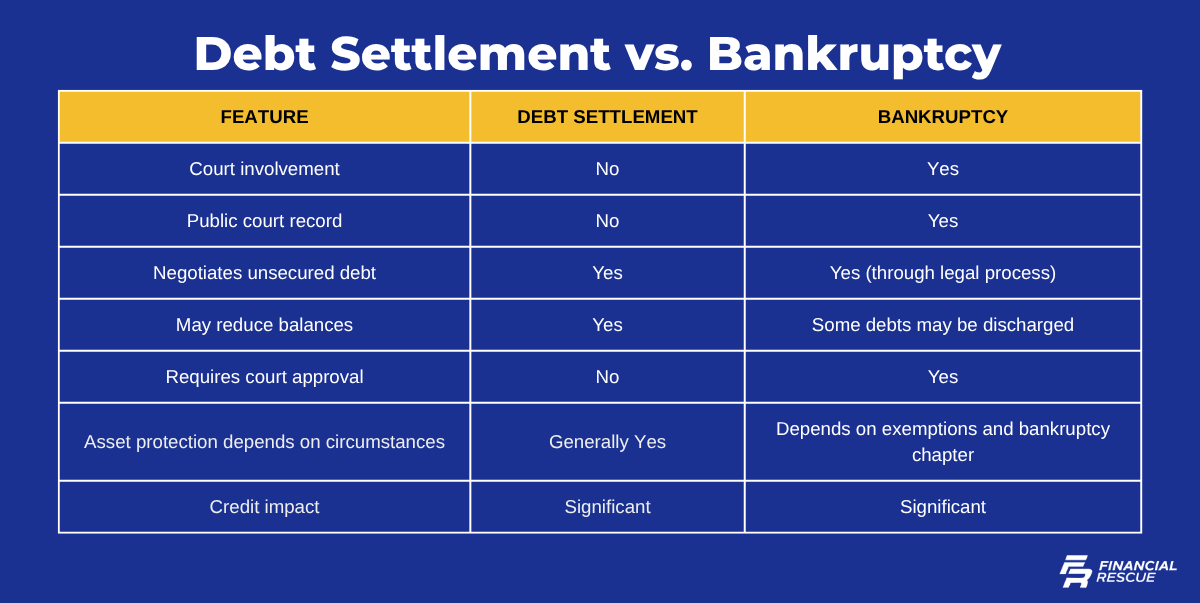
Neither option is inherently "better." The appropriate choice depends entirely on the individual's financial situation.
Advantages of Debt Settlement
Debt settlement may offer several potential benefits, including:
- Resolving certain unsecured debts for less than the full balance owed.
- Avoiding a formal bankruptcy filing.
- Allowing consumers to negotiate with creditors outside of court.
- Providing a path toward becoming debt-free without entering bankruptcy.
However, debt settlement also requires commitment, patience, and realistic expectations.
Advantages of Bankruptcy
Bankruptcy may provide important protections, including:
- Immediate relief from many collection efforts through the automatic stay.
- Potential discharge of eligible unsecured debts.
- Court-supervised legal protection.
- A structured path toward rebuilding finances after the bankruptcy process.
For some individuals facing severe financial hardship, bankruptcy may provide the most practical long-term solution.
Potential Disadvantages
Every debt relief option involves trade-offs.
Debt Settlement
- Creditors are not required to settle.
- The process may take time.
- Credit scores may be affected.
- Forgiven debt may have tax implications in certain situations.
Bankruptcy
- Bankruptcy becomes part of the public record.
- It may remain on your credit report for several years, depending on the chapter filed.
- Certain debts, such as many student loans, recent taxes, child support, and alimony, are generally not dischargeable.
- Some assets may be affected depending on applicable exemption laws and the type of bankruptcy.
Understanding these considerations is essential before choosing any financial strategy.
Common Myths
Myth 1: Bankruptcy eliminates every debt.
Not all debts can be discharged. Certain obligations remain legally enforceable even after bankruptcy.
Myth 2: Debt settlement guarantees creditors will forgive your debt.
Every creditor evaluates settlement offers independently. Outcomes vary from case to case.
Myth 3: Filing bankruptcy means financial failure.
Many financially responsible people experience unexpected hardships such as medical emergencies, job loss, divorce, or economic downturns. Bankruptcy laws exist to provide a legal opportunity for financial recovery.
Myth 4: There is only one solution for everyone.
No single debt relief option fits every individual. The best choice depends on each person's unique financial circumstances.
Real-Life Example
David and Anna, a Filipino-American couple, accumulated significant credit card debt after a prolonged period of reduced work hours and unexpected medical expenses.
Initially, they assumed bankruptcy was their only option. After reviewing their finances, however, they discovered they still had stable household income and several possible debt relief alternatives.
By carefully evaluating their financial situation and learning about the available options, they were able to make an informed decision based on their specific needs rather than fear or misinformation.
Their experience illustrates an important lesson: understanding your options is often the first step toward financial recovery.
Decision Framework
Every financial situation is unique, but these questions may help guide your decision:
- Can you realistically repay your debts within a reasonable period?
- Are your debts primarily unsecured, such as credit cards or personal loans?
- Do you own significant assets that you hope to protect?
- Has your income been permanently reduced, or is your hardship temporary?
- Have you fully explored all available debt relief options before making a decision?
Answering these questions can provide a clearer understanding of which path may be appropriate.
Frequently Asked Questions
Is debt settlement better than bankruptcy?
Neither option is universally better. The appropriate choice depends on your income, assets, debt amount, and long-term financial goals.
Does debt settlement eliminate all debt?
No. Debt settlement generally applies only to certain unsecured debts and depends on creditor participation.
Will bankruptcy permanently ruin my credit?
Bankruptcy has a significant impact on your credit history, but many individuals are able to begin rebuilding their credit over time through responsible financial habits.
Can I keep my home if I file bankruptcy?
It depends on the bankruptcy chapter, your equity, applicable exemption laws, and your overall financial circumstances.
Should I speak with a professional before making a decision?
Yes. Because every financial situation is different, understanding all available options before deciding is often one of the most important steps you can take.
Final Thoughts
Facing overwhelming debt can feel frightening, but it does not mean you have run out of options.
Whether debt settlement, bankruptcy, or another financial solution is appropriate depends on your individual circumstances. The most important step is not choosing the fastest solution—it is choosing the most appropriate one based on accurate information and careful evaluation.
Financial recovery begins with understanding your options, asking questions, and making informed decisions rather than acting out of fear.
Remember, seeking information is not a sign of failure. It is often the first step toward regaining control of your financial future.
Related Financial Recovery Insights
- Why Making Only the Minimum Credit Card Payment Can Cost You Thousands
- 7 Warning Signs Your Debt Is Becoming Financially Dangerous
- Best Way to Pay Off Credit Card Debt Fast: Proven Strategies for Financial Freedom
Financial Rescue
Financial recovery is more than becoming debt-free—it is about restoring peace of mind, rebuilding confidence, and creating a stronger future for yourself and your family.
Since 2008, Financial Rescue has been committed to helping Filipino-Americans understand their financial options and make informed decisions with confidence. Whether you are just beginning to explore your options or are ready to take the next step, remember that financial recovery is possible—and you don't have to face it alone.